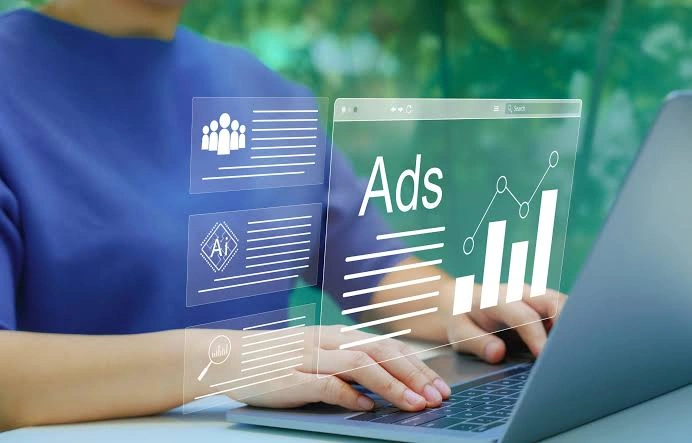
Artificial Intelligence (AI) is transforming the digital advertising landscape faster than ever before. From audience targeting and bid optimization to ad copy generation and predictive analytics, AI is helping businesses run smarter, more profitable campaigns.
For businesses investing in Google Ads, Meta Ads, LinkedIn Ads, or other paid advertising channels, understanding how to use AI for paid marketing is no longer optional it’s a competitive advantage.
At WaffleBytes, we’ve seen businesses significantly improve campaign performance by integrating AI into their paid marketing strategy. The result? Better targeting, lower acquisition costs, and higher returns on ad spend.
In this guide, we’ll explore how AI is reshaping paid advertising and how businesses can leverage it effectively.
What is AI in Paid Marketing?
AI in paid marketing refers to the use of machine learning algorithms and automation technologies to improve advertising performance.
Instead of manually adjusting bids, creating multiple ad variations, or analyzing large datasets, AI can process millions of signals in real time and make optimization decisions faster than any human marketer.
AI can help marketers:
- Optimize bidding strategies
- Generate ad creatives
- Improve audience targeting
- Predict customer behavior
- Increase conversion rates
- Reduce wasted ad spend
As advertising platforms continue to evolve, AI-powered advertising is becoming the standard rather than the exception.
Why Businesses Are Using AI for Paid Marketing
1. Improved Campaign Performance
AI continuously analyzes campaign data and identifies patterns that human marketers may overlook.
This allows businesses to:
- Increase click-through rates (CTR)
- Improve conversion rates
- Lower cost per acquisition (CPA)
- Maximize return on ad spend (ROAS)
2. Smarter Audience Targeting
Traditional targeting methods rely heavily on demographics and interests.
AI goes much deeper by analyzing:
- User behavior
- Purchase intent
- Browsing patterns
- Engagement history
- Device usage
- Location signals
Platforms such as Google Ads and Meta Ads use machine learning to identify users most likely to convert.
3. Automated Bid Management
Bid management used to require constant monitoring and manual adjustments.
AI-powered bidding strategies now automatically optimize bids based on:
- Device
- Time of day
- Location
- Search intent
- Competition level
- Historical conversion data
Examples include:
- Target CPA
- Target ROAS
- Maximize Conversions
- Maximize Conversion Value
These strategies help advertisers achieve better results with less manual intervention.
How to Use AI for Google Ads
Google has integrated AI into almost every aspect of its advertising platform.
Smart Bidding
Google’s Smart Bidding uses machine learning to optimize bids during every auction.
Popular AI-driven bidding strategies include:
- Target CPA
- Target ROAS
- Enhanced CPC
- Maximize Conversions
These bidding strategies use real-time signals to improve performance.
Responsive Search Ads
Instead of creating one fixed ad, advertisers can provide multiple headlines and descriptions.
Google’s AI automatically tests combinations and shows the best-performing variations.
Benefits include:
- Better click-through rates
- Higher Quality Scores
- Improved conversion rates
Performance Max Campaigns
Performance Max campaigns use AI to deliver ads across:
- Search
- Display
- YouTube
- Gmail
- Discover
- Maps
Google’s machine learning determines where your ads perform best and allocates budget accordingly.
How to Use AI for Meta Ads
AI has become central to Facebook and Instagram advertising.
Advantage+ Campaigns
Meta’s Advantage+ campaigns automate:
- Audience targeting
- Placements
- Budget distribution
- Creative testing
This allows businesses to focus on strategy while AI handles optimization.
AI Audience Expansion
Instead of restricting campaigns to narrow audiences, AI identifies similar users likely to convert.
This often leads to:
- Lower CPMs
- Better reach
- Higher conversion volume
Dynamic Creative Optimization
AI tests combinations of:
- Images
- Videos
- Headlines
- Primary text
- Call-to-actions
The platform automatically delivers the best-performing combinations.
Using AI for Ad Copy Generation
One of the biggest advantages of AI in paid marketing is content generation.
AI tools can help create:
- Headlines
- Descriptions
- Product copy
- CTA variations
- Display ad text
This dramatically reduces production time and allows marketers to test more variations.
However, AI-generated content should always be reviewed by human experts to ensure:
- Brand consistency
- Accuracy
- Compliance
- Emotional appeal
At WaffleBytes, we combine AI efficiency with human creativity to create high-performing ad copy.
AI for Landing Page Optimization
Driving traffic is only half the battle.
AI can also improve landing page performance by:
- Personalizing content
- Testing layouts
- Optimizing CTAs
- Predicting user behavior
Better landing pages lead to:
- Higher conversion rates
- Lower bounce rates
- Improved Quality Scores
Predictive Analytics and Forecasting
AI can analyze historical data to predict:
- Seasonal demand
- Conversion trends
- Budget requirements
- Customer lifetime value
This helps businesses make better marketing decisions and allocate budgets more effectively.
Common Mistakes When Using AI in Paid Marketing
Relying Completely on Automation
AI is powerful, but it still requires human oversight.
Marketers should regularly review:
- Search terms
- Audience quality
- Conversion tracking
- Creative performance
Poor Conversion Tracking
AI systems are only as good as the data they receive.
Incorrect tracking leads to poor optimization decisions.
Businesses should ensure:
- Conversion tracking is accurate
- Offline conversions are imported
- CRM integrations are working properly
Not Providing Enough Data
Machine learning performs better with larger datasets.
Campaigns with very limited budgets or conversions may require more manual management initially.
Best AI Tools for Paid Marketing
Popular AI tools include:
- Google Ads Smart Bidding
- Meta Advantage+
- ChatGPT
- Jasper AI
- AdCreative.ai
- Copy.ai
- HubSpot AI
- Optmyzr
These tools can improve efficiency and campaign performance when used strategically.
The Future of AI in Paid Advertising
AI is expected to become even more important in digital advertising over the next few years.
Emerging trends include:
- AI-generated video ads
- Predictive customer journeys
- Fully automated campaign structures
- Real-time personalization
- Voice and conversational advertising
Businesses that adopt AI early will likely gain a significant competitive advantage.
How WaffleBytes Helps Businesses Use AI for Paid Marketing
At WaffleBytes, we help businesses combine AI automation with expert strategy to maximize advertising results.
Our AI-powered paid marketing services include:
- Google Ads Management
- Meta Ads Management
- Conversion Tracking Setup
- Landing Page Optimization
- AI-Driven Campaign Optimization
- Performance Analytics and Reporting
We believe the future of paid marketing lies in the combination of technology and human expertise.
Final Thoughts
Learning how to use AI for paid marketing can help businesses reduce wasted spend, improve campaign performance, and scale faster than traditional advertising methods.
AI is not here to replace marketers it is here to make marketers more effective.
Businesses that embrace AI-powered advertising today will be better positioned to compete in tomorrow’s digital marketplace.
If you’re looking to integrate AI into your advertising strategy, the team at WaffleBytes can help you build smarter, more profitable campaigns.
