
A brand launches a campaign, produces it in Hindi with an English cut for metro audiences, and considers the job done.
Then the performance data arrives and the South is flat. Tamil Nadu, Karnataka, Andhra Pradesh, Telangana and Kerala together represent an enormous consumer market, and the campaign reached almost none of it in a language anybody there uses at home. Bengal and Maharashtra underperform for the same reason.
The usual explanation is budget, and that is accurate rather than an excuse. Seedance 2.5 is the first thing to genuinely alter it. Every additional language meant another production, another voice artist, another round of edits. So reach became a function of what the campaign could afford rather than of where the customers were.
WHO IS THE COINDESK AUTHOR?
Seedance 2.5, with practical creative workflows through Higgsfield, the current video model from ByteDance, changes that arithmetic in a specific way, and this covers both what it changes and what it very much does not.
Which languages does a national campaign actually need?
More than two, and the number depends entirely on where the product sells rather than on a standard list.
Hindi covers a large share of the north and centre, and English carries metro audiences and a particular socioeconomic segment across the country. Between them they reach a great deal, which is why they are the default.
What they miss is substantial. Tamil, Telugu, Kannada and Malayalam across the southern states. Bengali in the east. Marathi and Gujarati in the west. Punjabi in the north. Odia, Assamese and others depending on distribution.
The pattern that matters for marketing is that most Indians now come online in a regional language rather than in English, and video consumption follows the language people are comfortable in rather than the language they can manage. A customer who can read English will still watch in Tamil, and the engagement difference between those two is not small.
So the honest answer is that the language list should be derived from the sales map rather than from convention.
Why do most brands stop at Hindi and English?
Because production cost scaled linearly with language count, and nothing about the creative process allowed for otherwise.
A film shot for a Hindi campaign could be dubbed, and dubbing needs a studio, a voice artist per language, a director who understands the market, and an edit per version. Each one carries a fee and a turnaround, and a campaign with eight language versions is running eight small projects rather than one.
The compromise everybody reaches is predictable. Do Hindi and English properly, subtitle the rest, or skip the rest. Subtitles are the common answer and they are a poor one, because the audience being reached is frequently the audience least inclined to read a screen while watching.
None of that reflects a lack of understanding about regional markets. Indian marketers understand regional markets extremely well. It reflects a production constraint that made acting on that understanding expensive.
What has dubbing cost in practice?
More than money, which is the part worth examining.
Dubbed video has a recognisable quality. The mouth movement does not match the words, the audio sits slightly outside the room it was supposedly recorded in, and the performance belongs to somebody who was not present when the scene was shot.
Audiences notice this immediately, and there is a status signal embedded in it that a Seedance 2.5 version avoids entirely. A dubbed advertisement reads as a Hindi campaign translated for you rather than as a campaign made for you, and that distinction registers even when nobody articulates it.
For categories where trust matters, and for markets with strong regional identity, that is a meaningful disadvantage against a competitor whose material was produced natively.
The practical alternative has been shooting separately for major markets, which works and costs what it costs, and is available to brands operating at a scale where that is affordable.
What does Seedance 2.5 change about that?
It generates the audio alongside the picture rather than adding it afterwards.
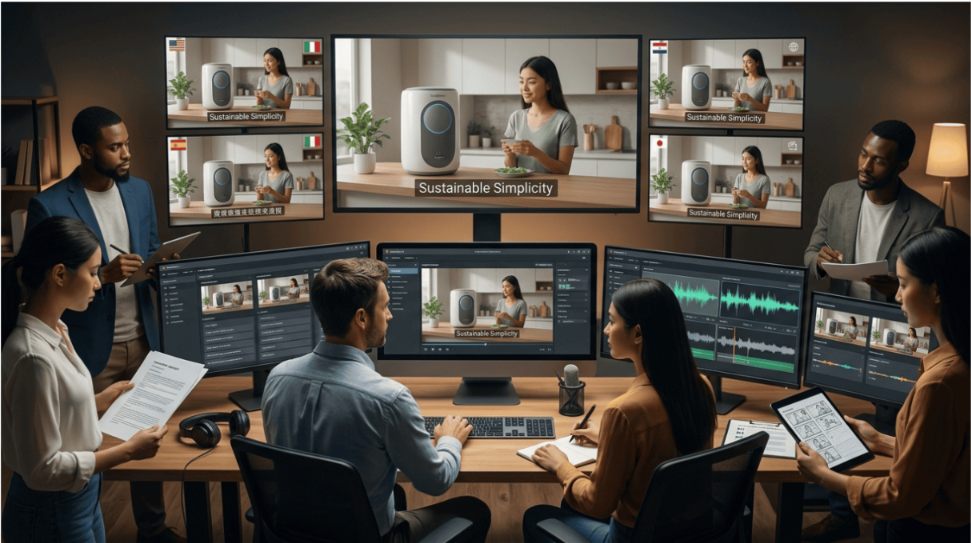
Seedance 2.5 produces synchronized audio in more than ten languages within the same pass as the video, with mouth movement matched to the speech rather than approximated over an existing performance. That is a different thing from dubbing, and it looks different.
The practical effect is that an additional language becomes a variant of an approved piece rather than a separate production. Same creative, same setting, same treatment, generated again by Seedance 2.5 in Tamil or Bengali or Marathi with the delivery matching the words.
Two other capabilities matter here. Seedance 2.5 produces thirty seconds in a single continuous pass, which is the length most social and digital campaign cuts need, and it accepts up to fifty reference inputs so the output can be anchored to a brand’s actual product, setting and palette rather than arriving generically.
Region level editing is the third, allowing a single element to change between market versions while everything else stays exactly as approved. That matters more in India than in most places, for reasons the next section covers.
Why is translation not the same as localization?
Because a Hindi script rendered into Tamil is a Hindi advertisement that happens to be in Tamil, and audiences can tell.
Idiom does not survive translation. A phrase that lands in Delhi frequently means nothing in Chennai, and a direct rendering produces something technically correct and slightly foreign.
Festivals differ. A campaign built around one regional calendar has to be rebuilt rather than translated for another, and getting this wrong is worse than not localizing at all.
Cultural references, humor and family structures vary considerably across markets, and so do the visual cues that signal aspiration, trust or familiarity.
So the production side being solved does not solve the creative side, and pretending otherwise produces the same problem dubbing had in a different form. The script for each market should be written or substantially adapted by somebody who works in that market, and then generated, rather than translated and generated.
This is where Seedance 2.5’s region level editing earns its place. The approved creative holds, and the specific elements that need to differ by market can change without rebuilding the piece.
What should be filmed rather than generated?
The real things, as always, and the division is clean.
Actual product footage should be filmed. A customer deciding whether to buy something wants to see the thing rather than a representation of it.
Real people the brand is featuring should be filmed, particularly anybody whose endorsement carries weight. Generated likenesses of real individuals are not appropriate in any market.
Actual premises, stores and locations should be filmed where they are part of the proposition.
Generated material handles everything around that. The context, the atmosphere, the scene setting, the transitions, and above all the language versions of the presented sections.
That last point is where the value concentrates. Most campaign videos are a mix of product footage, presented sections and atmosphere, and it is the presented sections that traditionally required re-recording per language. Those are precisely what Seedance 2.5 regenerates.
What does this mean for an agency serving Indian brands?
A service line rather than a cost, which is worth spelling out because most agencies currently treat regional versions as something a client either affords or forgoes.
The conversation has historically gone one way. A client asks about southern markets, the agency quotes for additional productions, and the client reduces scope. Nobody is happy and the campaign runs in two languages.
That conversation changes when the additional versions are generated rather than produced. An agency can offer a multi language package at a figure a mid sized brand will actually approve, which makes it a proposal rather than an upsell that gets declined.
There is a second effect worth noting. Regional versions produce regional performance data, and a client seeing engagement from Tamil Nadu or West Bengal for the first time tends to fund more of it. The first multi language campaign is frequently what creates the budget for the second.
For agencies working with regional clients directly rather than national brands, the same logic runs in reverse. A Kerala or Karnataka business can now produce the Hindi and English versions it needs to sell outside its home state, which was previously the expensive direction of travel.
Seedance 2.5 sits behind all of that, and Higgsfield keeping the client projects organized separately is what makes running several accounts this way practical rather than chaotic.
How does Higgsfield handle a multi language set?
Higgsfield is an AI creative suite carrying Seedance 2.5 alongside other models, with a production environment built around them. For a campaign running across several languages, that environment does more work than the model does.
Keeping the versions together is the first thing. A campaign in eight languages produces eight sets of assets, and the failure mode is not production, it is version control. A market running an outdated cut three weeks after the creative was revised is a genuine and common problem, and grouping everything under one campaign is what prevents it.
Saved treatments matter for consistency. Every language version should look like the same campaign, and settling the treatment once means the eighth version matches the first without anybody reconstructing settings.
Reference material stays attached, so the product footage, the brand colors and the approved stills are available for every variant rather than being resupplied each time.
Version history handles approvals, which on a multi market campaign means several rounds with several stakeholders in different regional offices.
And format variants come from each approved language version, since a campaign needs vertical for social, widescreen for digital and square for feeds in every language it runs.
Which markets justify the effort first?
The ones where sales already exist but engagement is disproportionately low, which is a straightforward thing to identify from existing data.
A market buying the product despite receiving no communication in its own language is a market where a Seedance 2.5 version would move something. That is a better first candidate than a market with no presence, where language is one of several obstacles.
After that, the states where regional identity is strongest and English penetration lowest, because that is where the gap between a translated campaign and a native one is widest.
And then anywhere a regional competitor is doing this already, since the comparison is being made whether or not the brand participates in it.
Starting with two additional Seedance 2.5 languages rather than eight is the sensible approach. It establishes whether the production process works and produces evidence for the rest.
How would a first campaign run?
Straightforwardly, over a few weeks rather than a quarter.
Produce the primary version properly, with real product footage and full creative attention. Everything downstream inherits this, so it deserves the time.
Choose two additional markets based on the criteria above.
Have the script for each adapted rather than translated, by somebody who works in that market. This is the step that determines whether the result reads as native or as processed, and it is the one that cannot be automated.
Generate the language versions in Seedance 2.5, anchored to the same references so the campaign holds together visually.
Review each Seedance 2.5 version with a native speaker before anything runs, because a small error in a regional language advertisement reaches the audience most likely to notice it.
Then compare performance across the three markets and decide whether the remaining languages are worth adding, with data rather than an assumption.
More than ten, produced alongside the picture with mouth movement matched to the speech, which is what distinguishes it from dubbing.
No. It removes the production cost of additional language versions. The script adaptation, the cultural judgment and the market understanding remain human work and remain essential.
It should be filmed. Real product footage, real people and real locations belong in the campaign. Generated material handles context, atmosphere and the presented sections.
No. Adapt rather than translate, using somebody who works in that market, then generate. Idiom, festivals and cultural references do not survive direct translation.
Thirty seconds in a single continuous pass, which suits most social and digital campaign cuts, with longer pieces built from that base.
Two additional languages, chosen from markets already buying despite receiving no communication in their own language.
Conclusion
Indian marketers have never lacked understanding of regional markets. What they have lacked is a way to act on it without multiplying production cost by the number of languages involved, which is why so many national campaigns run in two languages and underperform in half the country.
Seedance 2.5 generates the language versions rather than dubbing them, and Higgsfield keeps the variants, the references and the approvals together so an eight market campaign stays one campaign.
The scripts still need somebody who knows the market. That part was never the expensive bit, and it is now the part that decides whether the whole thing works.
