
Running a small business has never been easy. You wear multiple hats, manage limited budgets, and compete with companies that have far more resources. But something significant has changed in the past couple of years.
Artificial intelligence is no longer reserved for large corporations with deep pockets and dedicated tech teams. Today, some of the most powerful AI tools for small businesses are affordable, easy to use, and built specifically to help lean teams do more with less.
Whether you need help with marketing, content creation, customer support, financial management, or SEO, there is an AI-powered tool designed for exactly that job. And the businesses using these tools are growing faster, operating more efficiently, and competing at a level that was simply not possible before.
This guide covers the best AI tools for small businesses across every key area of operations, explains what each one does, and helps you figure out which ones are worth your time and money.
Why Small Businesses Need AI Tools in 2026
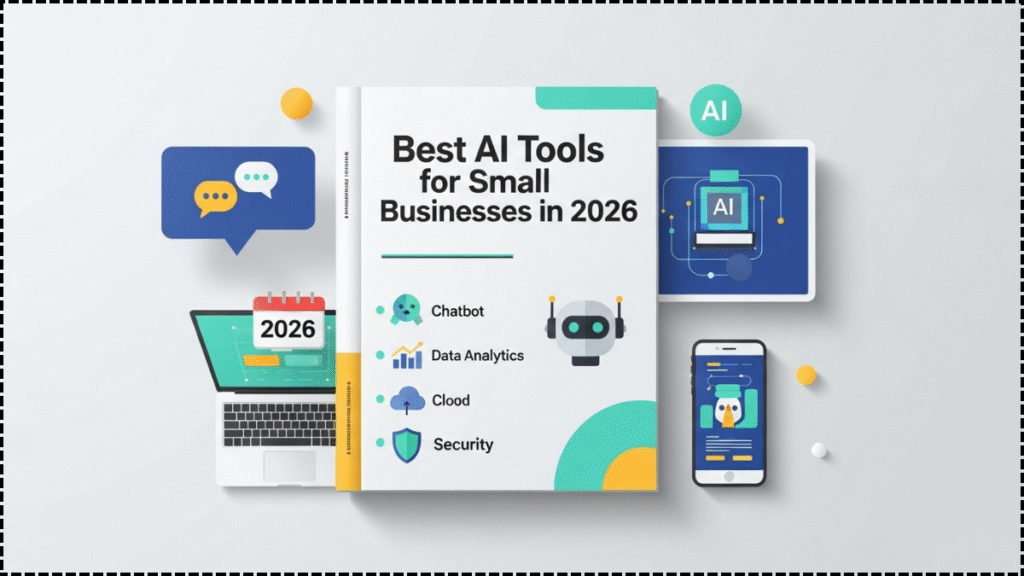
The business landscape has changed dramatically. Customers expect faster responses, more personalized experiences, and higher-quality content. At the same time, small business owners are stretched thinner than ever.
AI tools solve a very specific problem: they let small teams produce big-business results without big-business budgets. Here is why more small businesses are adopting AI faster than ever:
- Time savings: AI automates repetitive tasks so you can focus on what actually grows your business.
- Cost reduction: AI tools often replace the need for multiple hires or expensive agency retainers.
- Better decisions: AI analyzes data and surfaces insights that would take humans hours to uncover manually.
- Consistency: AI delivers consistent output whether it is answering customer queries, writing emails, or generating reports.
- Competitive edge: Small businesses using AI tools compete more effectively against larger, better-resourced rivals.
The question is no longer whether small businesses should use AI. It is which tools to use and how to get started.
Best AI Tools for Small Businesses: Category by Category
1. AI Tools for Content Creation and Copywriting
Content is the foundation of almost every digital marketing strategy. But producing high-quality blog posts, product descriptions, social media captions, and email newsletters consistently is one of the hardest challenges for small teams.
These AI writing tools make it significantly easier.
ChatGPT (OpenAI)
ChatGPT is one of the most versatile AI tools available for small businesses. You can use it to draft blog posts, write marketing emails, create social media content, answer customer FAQs, generate product descriptions, and brainstorm campaign ideas.
The free version is useful, and the paid plan (ChatGPT Plus) gives you access to more advanced capabilities. For small business owners who need a general-purpose writing assistant, ChatGPT is the obvious starting point.
Jasper AI
Jasper is built specifically for marketing content. It comes with templates for blog posts, ad copy, email subject lines, landing page content, and more. It also integrates with Surfer SEO, which means you can write and optimize content for search engines in the same workflow.
Jasper is more expensive than ChatGPT but offers more structure for teams that need consistent, on-brand content at scale.
Copy.ai
Copy.ai is ideal for small businesses that need short-form marketing copy fast. It excels at writing product descriptions, social media posts, email campaigns, and ad copy. The interface is simple and beginner-friendly, making it a great option if you are new to AI writing tools.
2. AI Tools for SEO and Search Visibility
Search engine optimization is one of the highest-ROI channels for small businesses. But it is also one of the most time-intensive. AI SEO tools make it possible for small teams to build and maintain strong search visibility without a dedicated SEO team.
Semrush
Semrush is one of the most comprehensive AI-powered SEO platforms available. It handles keyword research, competitor analysis, site auditing, backlink tracking, and content optimization. The AI features within Semrush help you identify keyword opportunities, analyze content gaps, and prioritize the fixes that will have the biggest impact on your rankings.
For small businesses serious about organic growth, Semrush is worth every penny of the investment.
Surfer SEO
Surfer SEO specializes in content optimization. When you write a blog post or landing page, Surfer analyzes the top-ranking pages for your target keyword and gives you a real-time content score. It tells you which topics to cover, how long the content should be, and which terms to include.
It pairs exceptionally well with any AI writing tool, making content creation faster and more strategically focused.
RankMath
If your small business website runs on WordPress, RankMath is one of the best AI-powered SEO plugins available. It provides on-page SEO recommendations, schema markup assistance, keyword tracking, and an AI-powered content assistant. The free version is surprisingly capable, and the paid version unlocks even more features.
3. AI Tools for Social Media Marketing
Social media is essential for small business visibility, but managing multiple platforms consistently is exhausting. These AI tools help you plan, create, and schedule social media content more efficiently.
Buffer
Buffer uses AI to help you plan and schedule social media posts across platforms like Instagram, Facebook, LinkedIn, X (formerly Twitter), and Pinterest. It also provides AI-powered suggestions for post timing, content ideas, and engagement optimization.
For small businesses managing their own social media, Buffer saves hours every week.
Lately AI
Lately AI is a social media content tool that uses AI to repurpose long-form content into dozens of social media posts. If you publish a blog post or record a podcast episode, Lately can automatically generate a week’s worth of social content from it. This is an incredibly efficient way to maximize the value of content you are already creating.
Canva (with AI features)
Canva has integrated several powerful AI features, including a text-to-image generator, AI-powered design suggestions, a background remover, and an AI writing assistant. For small businesses without a graphic designer, Canva’s AI tools make it possible to create professional-quality visuals for social media, presentations, and marketing materials in minutes.
4. AI Tools for Customer Support
Customer expectations around response times have changed. People want answers quickly, and small businesses that cannot respond fast enough lose customers to competitors who can. AI-powered customer support tools bridge that gap.
Tidio
Tidio is a live chat and AI chatbot platform built for small businesses. It lets you set up an AI chatbot on your website that can answer common customer questions instantly, qualify leads, take bookings, and escalate complex issues to a human agent.
The setup is straightforward, and the AI learns from your website content and FAQs to provide relevant, accurate answers. For e-commerce businesses in particular, Tidio can significantly reduce cart abandonment and support tickets.
Intercom (Fin AI)
Intercom’s Fin AI is one of the most sophisticated AI customer support agents available. It uses your existing help content to answer customer questions conversationally and accurately. For small businesses that receive a high volume of repetitive support queries, Fin AI can handle a large percentage of them without any human involvement.
Freshdesk
Freshdesk offers AI-powered customer support features including automated ticket categorization, response suggestions, and a self-service AI bot. It is a solid option for small businesses that manage customer support through email or a helpdesk system.
5. AI Tools for Email Marketing
Email marketing consistently delivers one of the highest returns on investment of any digital marketing channel. AI tools are making email campaigns smarter, more personalized, and more effective.
Mailchimp
Mailchimp has evolved significantly with AI features. Its AI capabilities now include subject line recommendations, send time optimization, audience segmentation suggestions, and a content generator that helps you write email copy. For small businesses already using Mailchimp, taking advantage of these AI features is a no-brainer.
ActiveCampaign
ActiveCampaign is one of the most powerful AI-driven email marketing and automation platforms for small businesses. It uses AI to predict the best time to send emails, personalize content based on subscriber behavior, and automate complex email sequences that nurture leads through the buying journey.
For businesses with even a modest email list, ActiveCampaign can significantly improve open rates, click-through rates, and conversions.
6. AI Tools for Finance and Accounting
Financial management is one of the most stressful parts of running a small business. AI-powered finance tools take much of the complexity and manual effort out of bookkeeping, invoicing, and financial reporting.
QuickBooks (with AI features)
QuickBooks is already the most widely used accounting software for small businesses, and its AI features make it even more powerful. AI-driven expense categorization, cash flow forecasting, invoice automation, and financial insights help small business owners stay on top of their finances without spending hours on bookkeeping.
Xero
Xero is a cloud-based accounting platform with strong AI automation features. It automatically reconciles bank transactions, categorizes expenses, and generates financial reports. For small businesses that work with accountants or bookkeepers, Xero makes collaboration significantly easier.
Fyle
Fyle is an AI-powered expense management tool that integrates with your business credit cards and automatically captures receipts, categorizes expenses, and generates expense reports. For small businesses with employees who travel or incur regular business expenses, Fyle eliminates the pain of manual expense tracking.
7. AI Tools for Project Management and Productivity
Small business teams need to stay organized and productive without the overhead of complex enterprise software. These AI productivity tools keep things moving efficiently.
Notion AI
Notion is already one of the most popular productivity and documentation tools for small teams. Notion AI adds a layer of intelligence that lets you summarize documents, generate content, extract action items from meeting notes, translate text, and draft project plans from a simple prompt.
For small businesses that use Notion for internal documentation and project management, the AI features are a significant upgrade.
ClickUp
ClickUp is a project management platform with built-in AI features that help teams write task descriptions, summarize project updates, generate action plans, and automate repetitive workflows. If your small business manages multiple projects or clients simultaneously, ClickUp’s AI capabilities can save hours every week.
Otter.ai
Otter.ai is an AI-powered meeting transcription and note-taking tool. It records and transcribes meetings in real time, identifies speakers, highlights key topics, and generates meeting summaries automatically. For small business owners who spend significant time in calls and meetings, Otter.ai eliminates the need to take notes manually and ensures nothing important gets missed.
8. AI Tools for Market Research and Competitor Analysis
Understanding your market and your competitors is critical for making smart business decisions. AI tools make this research faster and more accurate.
Crayon is an AI-powered competitive intelligence platform that tracks competitor websites, marketing campaigns, product changes, and pricing in real time. It surfaces relevant competitive insights so you can react quickly and position your business more effectively.
Exploding Topics
Exploding Topics uses AI to identify trends that are starting to gain momentum before they become mainstream. For small businesses looking to get ahead of market shifts, enter new niches, or identify product opportunities early, Exploding Topics is an invaluable research tool.
How to Choose the Right AI Tools for Your Small Business
With so many options available, it is easy to feel overwhelmed. Here is a simple framework for choosing the right tools:
Start with your biggest bottleneck. Identify the area of your business where you are losing the most time or money. If it is content creation, start there. If it is customer support, start there. Pick one problem and solve it before adding more tools.
Choose tools that integrate with what you already use. The best AI tools connect with your existing software. Check integrations before committing to any new platform.
Start with free trials. Almost every AI tool mentioned in this guide offers a free trial or a free plan. Test before you invest.
Measure the impact. Before and after adopting any AI tool, track the relevant metrics. Time saved, leads generated, support tickets resolved. Let the data guide your decisions.
Do not automate everything at once. Introduce AI tools gradually. Give your team time to learn each one before adding more complexity.
Common Mistakes Small Businesses Make with AI Tools
Even the best tools deliver poor results when used incorrectly. Here are the mistakes to avoid:
- Publishing unedited AI content: AI produces drafts, not finished products. Always review and refine before publishing.
- Using too many tools at once: Start with one or two tools and master them before expanding your stack.
- Ignoring data privacy: Be mindful of what customer data you feed into AI platforms, especially for regulated industries.
- Expecting AI to replace strategy: AI executes tasks. Strategic thinking and creative direction still require human judgment.
- Skipping the setup: Most AI tools require some configuration to deliver good results. Take the time to set them up properly.
Final Thoughts
AI tools are the great equalizer for small businesses. They give lean teams capabilities that were previously only available to companies with large budgets and dedicated departments. The businesses growing fastest in 2026 are not necessarily the ones with the most staff. They are the ones using the smartest tools.
You do not need to adopt every AI tool on this list. Start with the one that addresses your most pressing challenge, learn it well, and build from there. The compounding effect of multiple AI tools working together across your operations is genuinely transformative.
At WaffleBytes, we help small businesses build digital strategies that are smart, sustainable, and built for real growth. If you want to understand how AI tools can fit into your marketing and operations, get in touch with our team today.
Frequently Asked Questions
Top AI tools for small businesses include ChatGPT for content, Semrush for SEO, Tidio for customer support, Mailchimp for email marketing, and QuickBooks for accounting. Choose based on your biggest business need.
Yes. Most AI tools offer free plans or affordable subscriptions starting from a few dollars per month, making them accessible for businesses of all sizes and budgets.
AI tools automate repetitive tasks but cannot replace human creativity, strategy, or relationship management. They work best as assistants that help your team perform better.
AI tools save time, reduce costs, improve marketing performance, and enable faster decision-making, all of which allow small businesses to scale more efficiently than relying on manual processes.
Most reputable AI platforms have strong data security policies. Always review the privacy terms before inputting sensitive business or customer data into any AI platform.
